

Ma Bagalamukhi
About Devi Bagala
For followers of Sanātana Dharma in India, attaining inner, spiritual peace is essential. Yet this peace is not guaranteed simply by living a household life, nor does it automatically come by renouncing the world and becoming a monk. True spiritual peace resides only at the lotus feet of Śrī Śrī Mahāmāyā, and a seeker must surrender at Her feet with devotion—only then does peace arise.
In the Shakti tradition, one of the five core spiritual streams of Hinduism, success on the path requires making the mind fearless and free from desire. As many great Mother-worshipping sadhakas have said: unless the inner being becomes a cremation ground, the One who dwells in the cremation ground will never appear within. Even understanding the deeper meaning of the word Bhagavan can itself complete much of one’s spiritual practice.
“Bha” signifies the One who gives devotees the courage to rise above fear and attachment;
“Ga” represents infinite movement, without beginning or end;
“Ba” means the One who is not bound by any law or limitation of the world;
and “Na” denotes the imperishable, the eternal without dissolution.
Together, these qualities define Brahman itself—whom we call Bhagavan—who grants spiritual peace, infuses us with right energy, and helps us move forward on the path of life.
One of the most important disciplines on the Shakti path is Mahavidya sadhana. Tantric scriptures speak of the Ten Mahavidyas and also of eighteen forms. Among these, Devi Bagalamukhi holds a special place and is revered as the Eighth Siddha Vidya. Shakti eternally creates maya, and in her supreme form as Rajarajeshwari she subdued even Shiva—this very power manifests as Devi Bagala, the sovereign of all knowledge. After the seventh Mahavidya, Dhumavati, Bagala appears in full youthful radiance, emerging again through the nine cosmic energies. She has the power to protect, govern, and restrain the nine planets; for this reason, she is known as Siddha Vidya. Her mantras are inherently perfected, and through her worship a Mother-devotee may attain extraordinary spiritual powers.
Ancient tantric texts such as Pranatoshini Tantra, Brihat Tantrasara, and secret Bagalamukhi scriptures describe her manifestation. When Parvati once asked Shiva about this form, he explained that during Satya Yuga a great cosmic catastrophe engulfed the world—referred to in some texts as the storm-demon Madanasura. At that time, Lord Vishnu meditated on the Goddess near the sacred Haridra Lake in Saurashtra (present-day Gujarat). From the waters emerged Devi Tripurasundari, radiant in yellow, clad in yellow garments, seated on a jeweled throne—she was Bagalamukhi. In her form as Rajarajeshwari Bagalamukhi, she immobilized the destructive storm and saved the universe. Thus, tantric texts hail her as the destroyer of enemies—one who annihilates all inauspicious forces and proclaims the victory of divine good.
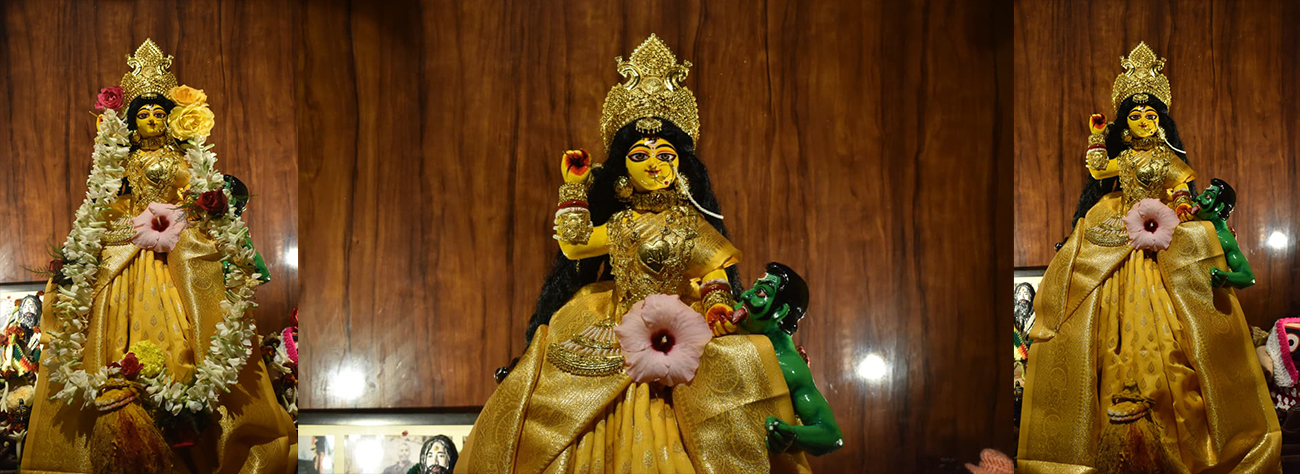
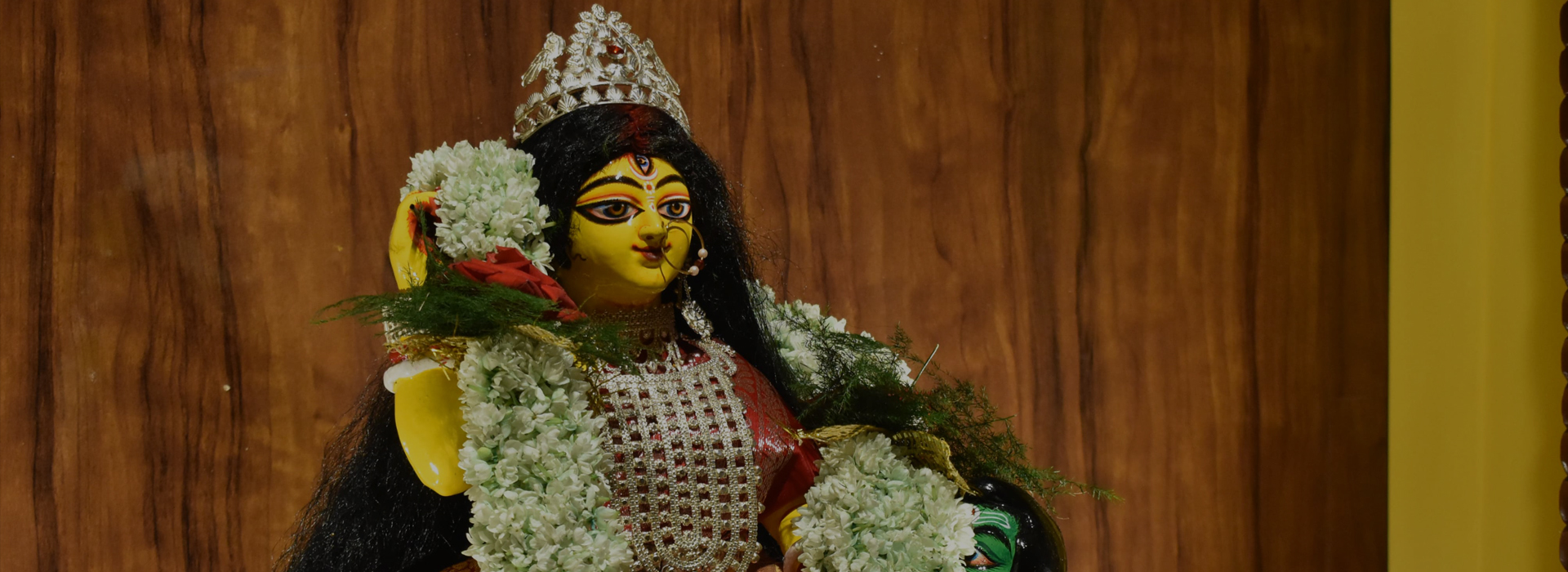
Tantric scriptures describe Bagalamukhi in many forms—two-armed, four-armed, eight-armed, ten-armed, eighteen-armed, even thousand-armed. She is most frequently mentioned in the Shri Shri Chandi text, where she is praised as the destroyer of enemies. In Bengal, she is most often worshipped in her two-armed form, known in Tantra as Stambhini—the one who can paralyze anything, even the entire universe. In one hand she holds a stone mace, and in the other, the tongue of a demon. She sits upon a corpse, symbolizing her dominance over all negative forces while bestowing positive energy upon her devotees. In many Bengali depictions, she is shown seated upon Shiva himself, envisioned there as the shava (corpse), emphasizing her supreme power.
Across India, the four-armed form of Bagalamukhi is widely worshipped and is described in scriptures as Brahmastra Vidya—the ultimate knowledge. She is Brahma-vidya itself, for at the end of all paths, liberation is found only through her. In her four hands she holds a mace, a thunderbolt, a noose, and the demon’s tongue. In this form she appears intensely fierce, ever-ready for battle, her body glowing like the sun. Her eight-armed and ten-armed forms are also revered.
It is said that worship of Devi Bagalamukhi destroys all kinds of enemies, grants success in life, and brings victory in disputes. These enemies are not only external—such as rivals in family or work—but also internal. Laziness, greed, jealousy, and ego that reside within the human heart are also enemies. The Mother destroys them all. Her mantra is believed to fulfill the sincere desires of the sadhaka, remove obstacles, protect against incurable diseases and long-term effects of accidents, and grant divine protection. Regular chanting of the Bagalamukhi mantra is said to dissolve ego and annihilate both inner and outer adversaries, guiding the devotee toward peace, strength, and spiritual fulfillment.